
Seven Churches of Revelation
The Seven Churches of Revelation were early Christian congregations in seven cities in the Roman province of Asia (modern-day western Türkiye) mentioned by St. John in the Bible. According to legend, these seven churches were all on a well-worn trade route, and each community received a specific message addressing its spiritual life. The first of these congregations was in Ephesus, followed by Smyrna, then the great city of Pergamon, Thyatira, wealthy Sardis, Philadelphia, and finally Laodicea. Each community received a letter calling them to repent of their sins and correct their current course. When the letters to the seven churches were written, there was an active Christian congregation in every city. Today, the ancient cities mentioned in the Book of Revelation still hold historical and cultural significance, drawing visitors and pilgrims from Christian communities around the world. The sites of the Seven Churches in Türkiye continue to welcome Christians as some of the most prominent destinations for faith travel.Because these sites are located relatively close to one another, they can be combined into a weekend trip focused on history and faith. Travellers who have more time can extend their stay to explore the wider region in more detail and learn more about its history and culture.
1. Ephesus (İzmir)
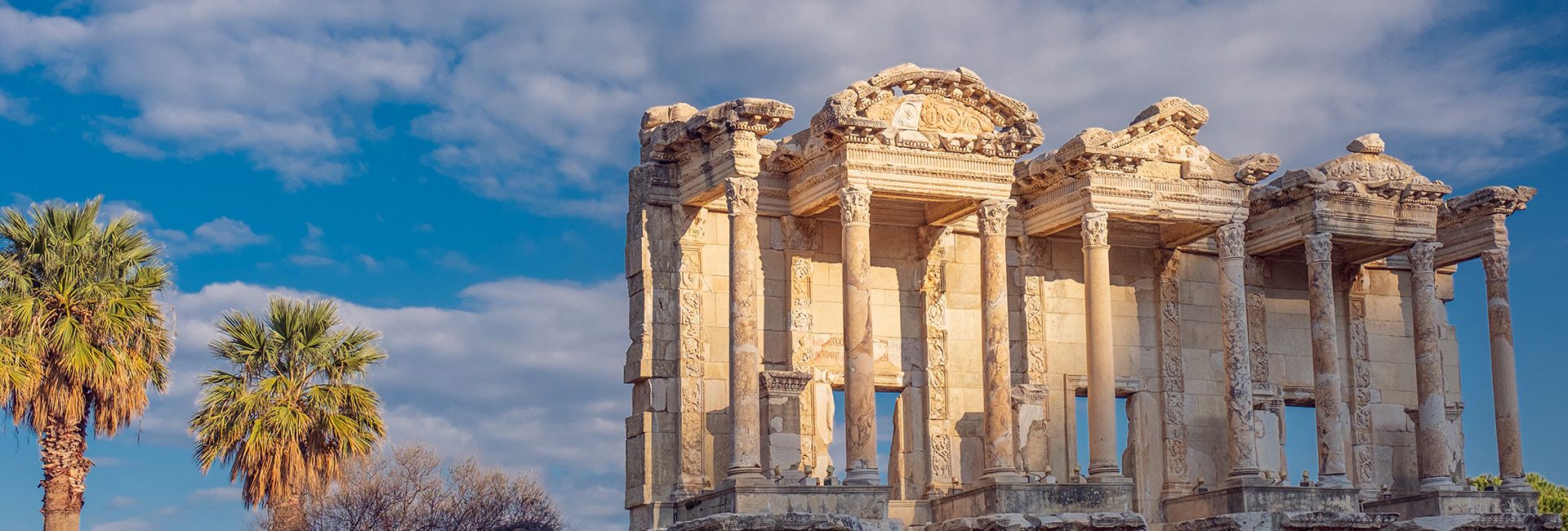
The first congregation mentioned by St. John in the Book of Revelation was in Ephesus, located in present-day İzmir. Ephesus has an important place in the history of Christianity, both politically and religiously, as it was one of the major cities of the Roman Empire. Today, the ancient city is on the UNESCO World Heritage List for its well-preserved ruins and monuments. It is believed that St. John the Apostle lived in this city towards the end of his life and wrote his Gospel and the Epistles of John here. The Virgin Mary is also said to have lived in Ephesus after the crucifixion of Jesus Christ, according to Christian tradition. It is also believed that St. Paul preached at the Great Theatre. The belief that the houses and tombs of important religious figures may be located in this city and its role as an important centre in the early spread of Christianity make Ephesus a sacred site for believers. This ancient city, which includes the site associated with one of the Seven Churches in Türkiye and other ancient ruins, invites you to a spiritual and cultural journey.
2. Smyrna (İzmir)
The second of these congregations was in Smyrna, one of the most prosperous and powerful cities of its time. Today, the remains of this ancient city are located in present-day İzmir. Christianity in Smyrna is thought to have grown out of the substantial Jewish population that once lived in the area, as some individuals converted from Judaism and were baptised into Christianity. Due to this critical role in the spread of the faith and the presence of one of the Seven Churches in Asia Minor here, the city has an important place in Christian history and is regarded as a sacred site for believers, continuing to be seen as a place of religious significance and attracting those who are interested in both faith and history.
3. Pergamon (İzmir)
Pergamon, one of the most visited ancient sites in İzmir and a UNESCO World Heritage Site, is associated with the third congregation mentioned in the Book of Revelation. This ancient city was formerly the capital of the Roman province of Asia. It was a centre of learning and culture with the famous Pergamon Library, which rivalled the Library of Alexandria. You can visit historic and architecturally important ruins such as the Asklepion, the Acropolis, and the ancient theatre today. In addition to its cultural and political importance, it is also regarded as a sacred site by many Christians. It was praised in the Book of Revelation for remaining strong in the Christian faith despite being in a city known for powerful pagan traditions and idol worship. The remnants of Pergamon stand as a testament to its rich cultural and artistic legacy, drawing Christians and visitors from around the world who wish to learn more about its religious and cultural heritage.
4. Thyatira (Manisa)
The fourth church mentioned in the Book of Revelation refers to the Christian congregation in Thyatira, located in the Akhisar district of Manisa today. Akhisar contains remains from the hill cemeteries of ancient Thyateira, and it is thought that the modern city developed over the area where the ancient city once stood. The connection between the city's past and present is particularly important for understanding its religious significance. The Grand Mosque in Akhisar stands on a site that is thought to have been occupied by an Eastern Roman (Byzantine) basilica, reflecting the city’s layered history of worship. Although the exact location of the earliest Christian congregation in Thyatira has not yet been identified archaeologically, some publications suggest that an early church used by this community may have stood in this area. Unfortunately, only a small part of the ancient city of Thyateira has survived to the present day. One of the clearest traces of the city's Christian past is the ruins of an Eastern Roman church.
5. Sardis (Manisa)
In the Book of Revelation, one of the seven congregations is addressed in Sardis, an ancient city located in modern-day Manisa. The city was the capital of the ancient Kingdom of Lydia and is considered the first known place in history where coins were minted under state guarantee. Known for its wealth and strategic location, it also had an important role in the spread of Christianity. Despite having a significant Jewish population and a strong influence of pagan practices, it is an important site for understanding the development of the Christian faith in Asia Minor. Sardis deserves to be visited for its architectural heritage, such as the remnants of the Temple of Artemis, a Jewish synagogue, and an Eastern Roman church, as well as its place in the history of Christianity. Visiting this ancient city offers a chance to better understand the daily life of past civilisations and their spiritual significance in early Christianity.
6. Philadelphia (Manisa)
Philadelphia, located in the Alaşehir district of present-day Manisa, is identified in the Book of Revelation as one of the seven congregations. The city has been buried under the modern settlement, but some ruins of the theatre and a temple have been uncovered through excavation. The most visible trace of the Christian past of the ancient city is the ruins of the Church of St. John, a sacred site for many Christians. In the Book of Revelation, the congregation in Philadelphia is praised for its devotion to the faith and its patience. The site is regarded as an important symbol of faithfulness and, therefore, a meaningful place of pilgrimage for believers. Feel the peaceful ambience of this place, which had great spiritual value in its time, as you wander among the few Eastern Roman remains.
7. Laodicea (Denizli)
In the Book of Revelation, the last of the seven congregations is addressed in Laodicea, a Hellenistic ancient city in present-day Denizli and one of the important centres of the region for centuries. In this passage, the congregation is warned against spiritual indifference and appeals for repentance and genuine devotion. This message, recorded in the Bible, still inspires the Christian communities due to its emphasis on devotion to faith. Today, excavation and restoration projects are being carefully carried out, revealing the important historic structures of the site. The reconstructed Laodicea Church (Basilica) features intricate mosaics and is a notable place to explore for visitors. With the biblical message conveyed to believers through this church and its important religious buildings, the site continues to be seen as a pilgrimage for believers and as a powerful symbol of early Christian heritage in the area.The best way to discover the sites of the Seven Churches of Revelation is to hire a car and travel around the region at your own pace. You can also join a tour and visit these important sites in Christian history with a guide. The sites, each once part of an ancient trade route, are situated between the coast and the lush greenery of the Aegean. Enjoy both the view and the tranquillity of a spiritual, historical, and cultural journey.