
With its historical role, natural beauty, beaches and thermal springs, Yalova stands out as the relaxation and holiday destination of the Marmara Region.
Apart from the forests, Karaca Arboretum, waterfalls, recreation areas, beaches and thermal springs, Yalova is also worth seeing with its historical past. The first settlements in this region date back to the 2000s BCE. Yalova also hosted civilizations such as Hittite, Roman and Ottoman empires.
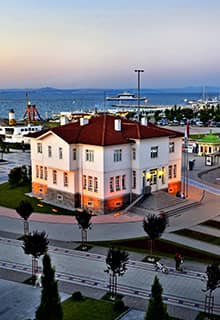
Yalova City Museum
Stopping by the Yalova City Museum (Yalova Kent Müzesi), you can bear witness to a history extending from the first settlement traces dating back 8 thousand years ago to the Ottoman Empire and the Republican Period.
The museum also grants wide coverage to Mustafa Kemal Atatürk, the founder of the Turkish Republic. Ethnographic artifacts, documents, decorations and models within the museum also shed light on the cultural, geographical and historical past of the city.
The Walking Mansion
The mansion was built by Mustafa Kemal Atatürk, the founder of the Turkish Republic, in 1929. According to the story, one day Atatürk saw a gardener trying to cut the branches of the plane tree adjacent to the mansion when he came to the farm. The gardener told him that the branches were too long and pushed against the walls of the mansion. After hearing this, Atatürk orders: "Don’t cut the tree, move the building."
A technical staff first dug the ground and reached the foundation, then put the mansion on rails that and moved it away from the tree by 4.80 meters on Aug.10, 1930. Thus, the great plane tree evaded being cut down.
Since then the name of the mansion has been known as "The Walking Mansion."(Yürüyen Köşk) Atatürk stayed at the mansion between 1930-1937 intermittently. A study conducted in 2015 found out that the plane tree is of the Oriental Plane (Platanus orientalis) family and is 390 years old.
Karaca Arboretum
It is possible to see about 7 thousand different plant species in the arboretum founded on 13.5 hectares. Türkiye's first private arboretum, or botanical garden, Karaca Arboretum (Karaca Arboretumu) was founded by Hayrettin Karaca.
It hosts many species and culture forms of Acer, Prunus, Malas, Magnolia, Quercus, Betula, Pinus, Agabeyes Picea species.
In June 2004, Karaca Arboretum was awarded by the International Dendrology (Tree Science) Society.
Black Church
If you are interested in the Byzantine period, you will definitely want to see this building which was used as a bathhouse in the 8th century BCE and as a church in the 8th-9th century CE.
The church was built in the early Byzantine period, and a double narthex and apsis were added later. The building is in cross shape form with a wide door. In the middle section, there is a ringed dome with eight windows.
There are also ruins of an ancient harbor and aqueducts on Çiftlikköy coast where the Black Church (Kara Kilise) is located.
Hersekzade Ahmed Pasha Mosque
Hersekzade Ahmed Pasha Mosque (Hersekzade Ahmed Paşa Camii) was built by Hersekzade Ahmed Pasha, who served as the grand vizier during the reign of Sultan Bayezid II and Selim I. It is located along the coast of Izmit Gulf, between Karamürsel and Yalova.
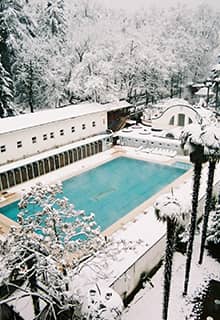
Kurşunlu Bath
Kurşunlu Bath (Kurşunlu Hamamı) was built 16 centuries ago by Emperor Justinian during the Byzantine period. Over time, it was damaged by wars and buried in the ground, however it was restored in 1900 by the order of Ottoman Sultan Abdulhamid II. Since the top of the bath is covered with lead, it is called kurşunlu which means "leaded".
It includes a large indoor pool, sauna, shower and bath rooms. The decorations are concentrated on the east and south facades. The reliefs on the dome ring are remarkable. "Heracles" is depicted in a frame and three female saints are depicted at the bottom.
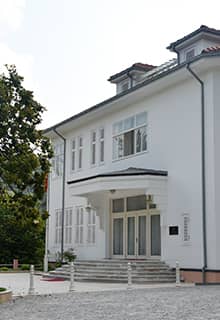
Termal Atatürk Mansion
Atatürk Mansion (Atatürk Köşkü) was built by Architect Professor S. Hakkı Eldem in the Termal district of Yalova. The mansion was built in 38 days with two floors, by using only wood. After its construction was completed, Iranian Shah Reza Pahlavi became the first guest to visit the mansion.
Mustafa Kemal Atatürk took important decisions such as the establishment of the Turkish Historical Society and Turkish Language Association, the translation of the Holy Quran into Turkish, and the transition to the multi-party system at this mansion.
The mansion, which is preserved with the items specific to the period when it was built, is open to visitors today as a museum. The mansion, one of the early examples of the Republican Era architecture, is also famous as a place where Atatürk frequently talked with his citizens.
Rüstempaşa Mosque
It is thought to have been built by Rüstem Pasha (1500 - 1561), the grand vizier of Süleyman the Magnificent, as a complex which consists of a mosque, inn and bath. Its date of construction is uncertain. Only the mosque and baths have survived from the complex.
Armutlu Thermal Springs
Armutlu Thermal Springs (Armutlu Kaplıcaları), one of Türkiye's most important thermal springs, is composed of different resources lined up over a river bed in a valley.
Although the existence of the springs has been known and its waters have been used since the Byzantine period, they were discovered after the Thermal Springs. It is closer to the sea when compared with Thermal Springs, giving visitors the pleasure of sea and thermal springs together. The beauty of the dense forest it is located in and its scenery increases its relaxing effect.
The water temperature ranges from 57 degrees Celsius to 73 degrees Celsius. In terms of chemical classification, thermal spring waters have a composition of sulphate, bicarbonate, chloride, calcium, sodium and carbon dioxide.
İbrahim Müteferrika Paper Museum
The first paper house of the Ottoman Empire was founded in Elmalık village of Yalova. The printing house, which was run by İbrahim Müteferrika, the first printer of the Ottoman Empire, is significant in terms manufacturing the paper, which was all imported at that time.
İbrahim Müteferrika Paper Museum (İbrahim Müteferrika Kâğıt Müzesi) stands as being Türkiye's first paper museum. The museum offers information on the history of paper, its production, preservation, paper arts, Turks and the paper industry, the history of books and librarianship to the visitors.
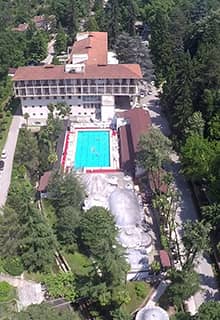
Termal Hot Springs
Termal Hot Springs (Termal Kaplıcaları) are located in the city center of the Termal district of Yalova and they stand out as the most complex hot spring area of Türkiye.
Famous for its hydrangeas, Termal also hosts quite rare trees. It has 39 types of deciduous trees, 26 types of evergreen trees, 25 types of deciduous and evergreen shrubs, and 18 types of ivy type plants. There are pine, magnolia and other types of trees in Güney Park.
Influenced by different cultures in history, Termal gained importance during the Roman period. According to the research, Termal Hot Springs, known to have emerged as a result of a prehistoric earthquake have been named Pythia Therma since the 6th century. This was because it was thought to belong to an underground god because of the steam and hot water that emerged in the earth’s crevices. The Elixir of Life thermal baths, built by Constantine and restored by Justinian, are among the most popular thermal springs.
The thermal springs, which gained importance again in the time of Sultan Abdülhamid, took their final shape during the period of Great Leader Mustafa Kemal Atatürk. He frequently visited Termal to get some rest and spend some time here.
Termal Hot Springs waters were examined by the Society of Medicine in 1892, and a hotel and a bath were built here after it was discovered that the waters were of equal quality with the waters of Aix Les-Bains.
Various votive steles, tombstones, a church and a tunnel, columns bearing the monogram of the Byzantine Emperor Justinian II (C.E 565-578) were found in the studies launched in 1932 with the excavation order given by Atatürk.
Ortaburun Pond
Situated within the boundaries of Ortaburun village in the Çınarcık district of Yalova, Ortaburun Pond (Ortaburun Göleti) is one of the pristine natural retreats of the Eastern Marmara region. Surrounded by dense pine, oak, and hornbeam forests that reflect vibrant green tones across its waters, the pond offers a serene atmosphere favored by nature enthusiasts and landscape photographers.
Characterized by its tranquil ambiance, fresh air, and rich flora, the area surrounding the pond provides ideal conditions for outdoor activities such as hiking, camping, recreational angling, and picnics. Displaying distinct seasonal palettes throughout the year, Ortaburun Pond serves as an inviting eco-tourism destination for travelers seeking a peaceful escape into nature in Türkiye.
Hersek Lagoon and Bird Watching Tower
Situated within the boundaries of the Altınova district in Yalova, just 27 km from the city center, Hersek Lagoon (Hersek Lagünü) is a captivating 167-hectare natural wetland separated from the Sea of Marmara by a narrow coastal barrier strip. Characterized by its rich biodiversity and ecological significance, the lagoon serves as one of the most vital wetland habitats in Türkiye's Marmara Region.
Hersek Lagoon offers a vital habitat not only for wintering waterfowl but also for summer migratory birds that arrive during the warmer months for breeding. The site hosts important bird species that nest in colonies, particularly along the delicate coastal strip between the sea and the lagoon. Serving as a crucial stopover on international avian migration routes, the wetland regularly harbors large populations of flamingos alongside hundreds of other bird species.
Located right on the edge of the wetland, the Hersek Lagoon Bird Watching Tower provides an exceptional viewing platform for nature enthusiasts, researchers, and photographers. Notable as Türkiye's first fully accessible bird observation tower, the structure allows visitors to enjoy panoramic views and observe wildlife without disturbing the delicate lagoon ecosystem. Complemented by an adjacent nature education center, Hersek Lagoon stands as one of Yalova's premier eco-tourism destinations.
Çınarcık
Situated on the Sea of Marmara coastline of Yalova, is one of the most established and popular resort towns in the Marmara Region, celebrated for its clean beaches, vibrant social scene, and lush natural surroundings. Due to its close proximity to Istanbul and neighboring provinces, the district draws high volumes of visitors during the summer season and is fondly referred to as the "Pearl of the Marmara."
Renowned for its long beach promenade, bustling seaside venues, and active nightlife, Çınarcık also benefits from the stunning natural landscapes of the backing Samanlı Mountains. The nearby Teşvikiye area hosts famous eco-tourism destinations such as the Delmece and Erikli plateaus along with picturesque waterfalls, offering exceptional routes for hiking, camping, and nature photography. Blending coastal relaxation with mountain escapes, Çınarcık stands out as a flagship holiday destination in Türkiye.
Dilburnu Lighthouse Museum
Located on the Hersek Peninsula right beneath the Osmangazi Bridge in the Altınova district of Yalova, the Dilburnu Lighthouse Museum (Dilburnu Deniz Feneri Müzesi) is a specialized cultural venue dedicated to Türkiye’s maritime and lighthouse heritage. Set within and around the compound of the historic Dilburnu Deniz FeneriDaha fazla bilgi için yan paneli tıklayarak açın—which has guided vessels through the Gulf of İzmit since 1863—the museum offers an engaging journey into the history of coastal navigation.
The museum complex displays historical lighthouse mechanisms, Fresnel lens systems, vintage navigation tools, archival documents, and authentic maritime artifacts. Beyond technological displays, it also sheds light on the traditional way of life and daily routines of lighthouse keepers and their families. Integrated with the neighboring Hersek Lagoon, the Accessible Bird Observation Tower, and the Botanical Garden, the museum forms part of an enriched eco-cultural circuit. Blending rich maritime history with panoramic views of the Sea of Marmara and the modern bridge, it stands out as a unique destination in Türkiye.
Valide Bathhouse
Located in the Termal district of Yalova, Valide Hamamı (Valide Bathhouse) is one of the region's most historic healing centers, originally built approximately 1,600 years ago by the Eastern Roman Emperor Constantine. Offering therapeutic thermal waters across centuries, this ancient structure underwent a major restoration during the Ottoman era under the reign of Sultan Abdülmecid.
The bathhouse acquired its current name after Sultan Abdülmecid’s mother, Bezmiâlem Valide Sultan, stayed here to undergo successful thermal treatments. In honor of her recovery, the complex became known as the Valide Bathhouse. Today, the active facility seamlessly blends its Eastern Roman origins with Ottoman marble architecture, welcoming visitors to experience its renowned mineral-rich thermal waters nestled in the lush forests of Türkiye.
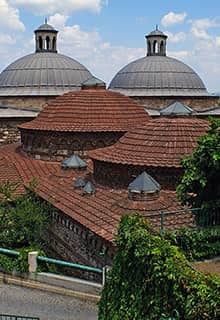
Armutlu Thermal Springs Armutlu Bath
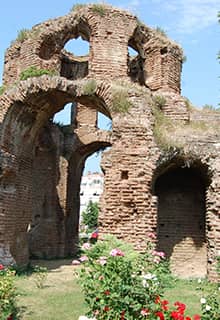
Black Church
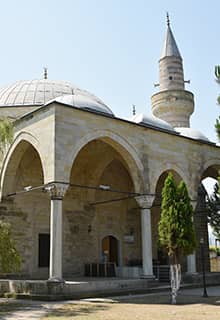
Hersekzade Ahmet Pasha Mosque
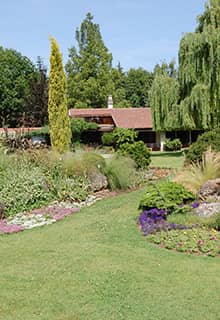
Karaca Arboretum
Thermal Atatürk Mansion
Kurşunlu Bath
Yalova City Museum
Thermal Hot Springs