
The Oracles of Apollo: Anatolia’s Ancient Prophecy Centres
Across the landscapes of western Anatolia, where ancient routes once connected coastal cities with inland sanctuaries, the traces of Apollo’s oracles remain. These sacred places, established in different cities and regions, formed a network of prophecy centres that shaped religious life in the ancient world.
Through temple ruins, inscriptions, and the accounts of ancient authors, the memory of these sanctuaries preserves a tradition in which divine messages were believed to guide both individuals and entire communities.
This guide explores the oracular tradition of Apollo in Anatolia, focusing on its historical background, architectural features, and the sites.
Apollo and Oracle Tradition in the Ancient Greek World
In ancient Greek belief, Apollo was associated with prophecy, light, and order, and was widely regarded as the god through whom divine knowledge could be revealed. His sanctuaries functioned as places where mortals sought guidance, often before making significant political or personal decisions.
The practice of consulting an oracle usually involved priests or priestesses who interpreted signs, dreams, or spoken responses believed to originate from the god. Anatolia hosted several important oracular sites connected to Apollo, which formed part of a wider religious landscape influenced by the movement of ideas, rituals, and artistic traditions across the Aegean world.
Features of Apollo’s Oracles
Although varying in scale and regional state, Apollo’s oracles shared several architectural and functional characteristics. Most were established within sacred precincts, often positioned in locations considered spiritually significant, such as near springs, caves, or elevated grounds.
The temple itself typically formed the focal point of the sanctuary, accompanied by altars, stoas, and auxiliary structures. In some cases, enclosed or restricted sections of the sanctuary were associated with prophetic practices, reinforcing the connection between the physical setting and the act of divination.
These sanctuaries also functioned as gathering places, where rituals, festivals, and consultations took place, reflecting their role not only as religious sites but also as centres of communal life.
Open-Visit Sanctuaries in Western Anatolia
Today, several of Apollo’s sanctuaries in Türkiye can still be visited, their remains continuing to reflect the scale and significance they once held. These sites provide a tangible connection to the religious life of ancient Anatolia and allow visitors to experience the spatial and ceremonial aspects of Apollo’s cult firsthand.
Didyma
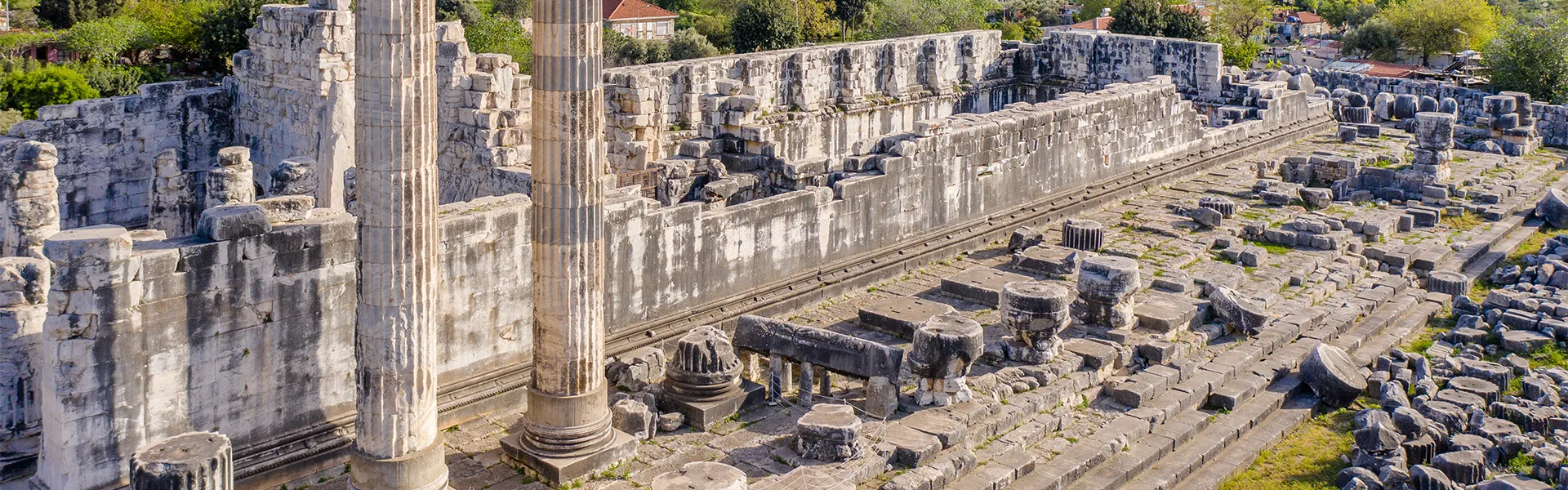
The sanctuary of Didyma, near Miletus, stands as one of the most prominent examples. Its monumental temple, known for its vast columns and intricate layout, once housed an influential oracle that rivalled other centres of the ancient world.
The sanctuary was historically connected to the city of Miletus by a 17-kilometre-long Sacred Way, which was lined with statues and used for ritual processions by those seeking divine guidance. The site preserves its imposing structure, allowing visitors to trace the pathways once followed by those seeking prophecy.
Didyma is also part of Türkiye’s Night Museums programme, with evening visits available during the season. Visitors can explore the illuminated columns and temple remains under night lighting.
Claros
Further north, the Temple of Apollo at Claros, near ancient Colophon, functioned as another major oracle centre. Claros functioned as an important cult centre dedicated to Apollo, with a distinct emphasis on oracular practices. The remains of the temple complex, along with inscriptions found on site, continue to shed light on its ritual organisation.
Patara
In Patara, located along the Lycian coast, the cult of Apollo formed an important part of the city's religious life. Ancient historians, including Herodotus, describe Patara as a place where prophetic activity took place only during specific periods rather than throughout the year.
It is also associated in some sources with the birth of Apollo and Artemis, further highlighting its significance in Lycian mythology and cult traditions. The site connects coastal life with sacred tradition and reflects the diversity of Apollo’s worship across regions.
Chryse (Apollo Smintheus)
Located in the Troad (Çanakkale), this site is notable for its "Sminthean" cult, in which Apollo was worshipped as the 'Lord of the Mice.' The temple features rare reliefs depicting scenes from Homer’s Iliad. Archaeological work has confirmed its role as a significant oracular and religious hub for the northern Aegean, and the site is fully open to visitors with a well-organised museum.
Sites That Partly Survive
In addition to the better-preserved sanctuaries, several centres associated with Apollo survive only in partial form, with visible remains limited to foundations, scattered architectural fragments, or sections revealed through excavation.
In Side, the Temple of Apollo survives in a partly reconstructed form along the coastline. While it is not clearly identified as an oracular centre, its presence indicates the importance of Apollo’s cult within the city.
Although these sites no longer retain their complete form, they continue to contribute to the broader understanding of Apollo’s cult and preserve traces of ritual practices and spatial organisation.
Known Through Texts and Inscriptions
Some of Apollo’s oracular centres in Anatolia are known only through ancient texts, inscriptions, or later historical references. While their physical remains have not survived or have yet to be identified, written sources indicate their existence and importance.
Among the most notable of these is the sanctuary of Gryneion, located near the ancient city of Myrina. Ancient authors describe it as a sacred site dedicated to Apollo, associated with a grove and religious activity, though its role as an oracle centre is not as well documented as that of Didyma or Claros.
Ancient authors, along with epigraphic evidence, suggest that additional temples and sanctuaries dedicated to Apollo once existed across western Anatolia. These references, though limited, help reconstruct a wider network of prophecy centres extending beyond the sites known today.
General Information for Visitors
Visitors interested in exploring the oracles of Apollo in Türkiye can access several open archaeological sites, particularly in the Aegean region. These sites are generally open year-round, though opening hours may vary by season.
For up-to-date information, it is advisable to consult the official museum or site management resources before planning a visit. Exploring these sanctuaries with attention to their historical context allows for a deeper understanding of the cultural and religious traditions they represent.
Whether through monumental remains or fragmentary traces, the oracles of Apollo continue to reflect a belief system that shaped the ancient world and preserves its presence within the landscapes of Anatolia.