
Pamukkale Travertines: Formation, Characteristics & Activities
Among Türkiye’s iconic tourism destinations, Pamukkale travertines effortlessly captivate thousands of domestic and international visitors each year. Located in Denizli, the region’s appeal lies in the extraordinary formations and the striking landscapes they create.
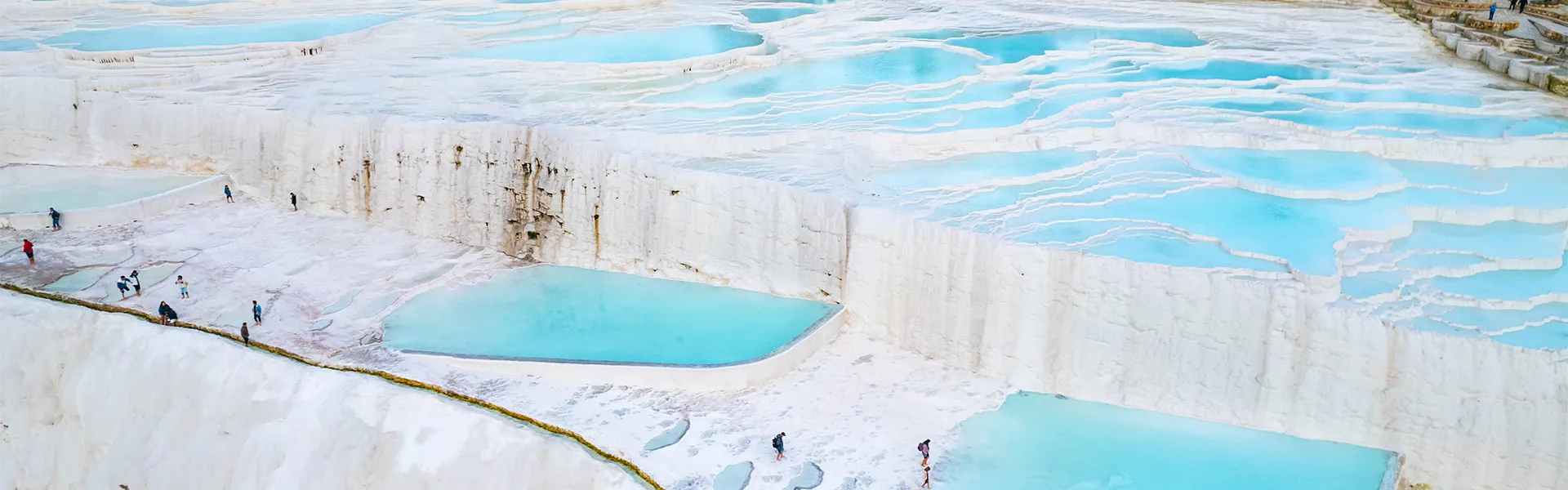
The terrace-type travertines were formed as mineral-rich waters emerging from springs along fault and fracture systems flowed down the slopes, creating the unique formations that give the region its distinctive charm.
Travertine is a chemical sedimentary rock formed by the precipitation of carbonate and calcium. It develops through both chemical and physical processes and is most commonly found in geothermal areas.
In the travertine formations, whose colours range from white to cream and yellow depending on the iron, sulfur, and other minerals in the water, the continuous flow of hot water is essential for their ongoing formation. As a result, conservation efforts become essential to preserve this delicate process.
Now, let’s delve into the captivating story of this natural wonder of Türkiye and discover what makes it so extraordinary.
How were Pamukkale Travertines Formed?
Pamukkale travertines are formed when water containing a high amount of calcium hydrogencarbonate comes into contact with oxygen in the air. This contact causes carbon dioxide to evaporate, leading to the precipitation of carbonate and the formation of travertine.
Today, the active formation of the terraced white limestone pools is sustained by waters emerging from springs with temperatures ranging between 35 and 36°C. On the other hand, as Pamukkale is a tectonic region, many of the older springs have shifted location due to tectonic movements.
Moreover, travertine formations aren’t unique to Türkiye; you can also find similar formations in Tivoli, Italy, and Yellowstone National Park in the United States. Still, Pamukkale stands out as one of the most remarkable examples in the world, thanks to its scale and its striking, uniform white terraces.
Characteristics of Pamukkale Travertines
The stunning white calcium pools of Pamukkale are defined by a set of remarkable structural features that give them their unique appearance.
The common features are:
- The word “Pamukkale” translates to “cotton castle” in Turkish. Pamukkale’s cotton-like appearance comes from the reflection of sunlight on calcite crystals. In its purest form, it looks bright white, though higher mineral content in the water can give it cream or yellowish tones.
- Pamukkale travertines form in a series of small, step-like pools, shaped by the flow of hot water and the slope of the terrain.
- Tiny cavities trapped in the minerals left behind by the waters give the travertines a light, sponge-like appearance.
- As mineral-rich thermal waters flow over the terraces, they continuously shape and refresh the travertines, keeping their surfaces vibrant and alive. For this reason, preserving the natural direction of the water flow is essential.
Amazing Activities to Do at Pamukkale Travertines
Pamukkale is also home to the ancient city of Hierapolis, where you can explore fascinating remnants and enjoy a variety of unforgettable experiences.
Walk Barefoot on the Travertine Pools
One of Pamukkale’s most iconic rituals is walking barefoot on the travertine terraces. You can stroll through the white terraces without shoes, wading in warm water up to your knees and feeling the soft calcite deposits beneath your feet. Especially at sunset, the natural thermal pools glow with golden light, creating unforgettable scenes straight out of a postcard.
Take a Dip in the Ancient Pool
Maintaining a constant temperature of 36°C throughout the year, the Ancient Pool is fed by mineral-rich thermal waters that have long been associated with a variety of benefits and are believed to support overall well-being.
What makes the experience even more remarkable is the opportunity to swim among submerged ancient columns and archaeological remains scattered beneath the water. According to local legend, even Cleopatra once visited the area to bathe in these restorative waters.
Situated within the UNESCO-protected ancient city of Hierapolis, next to Pamukkale’s iconic travertine terraces, the pool was formed after a powerful earthquake in 692 AD created a depression that was gradually filled by thermal waters.
Enjoy Gyrocopter Flight Over the Travertines
For a more thrilling aerial adventure, take a gyrocopter flight over Pamukkale and experience the landscape from a unique perspective. Combining the agility of a helicopter with the smooth gliding sensation of an aircraft, gyrocopters offer a dynamic way to explore the region from lower altitudes.
As you soar above the dazzling travertine terraces and the ancient city of Hierapolis, breathtaking views unfold beneath you. With the wind around you and no barriers between you and the scenery, the experience feels remarkably close to flying like a bird.
Take a Balloon Ride
A hot air balloon ride is one of the must-do experiences in Pamukkale, offering a completely different perspective of its world-famous white terraces. As you drift above the landscape, you can admire the striking contrast of the travertines, the ancient ruins of Hierapolis, and the vast plains stretching into the distance. Early morning flights often coincide with sunrise, making the views even more spectacular.
Explore Magnificent Hierapolis
Right above the travertines lies the ancient city of Hierapolis, a UNESCO World Heritage Site along with Pamukkale since 1988. Here, you can wander through its temples, ancient theatre, the Roman bath complexes, Plutonium Sanctuary, and more.
When the sweeping views of the remnants merge with Pamukkale’s incredible natural sights, you get a truly magical glimpse of Türkiye’s beauty.
Stay at Thermal Hotels Nearby
Around Pamukkale, you’ll find thermal facilities that let you soak in the region’s soothing waters while enjoying modern spa experiences. After a day of exploring, you can unwind in warm thermal pools, indulge in mud baths, or treat yourself to a relaxing massage.
Hike Through Peaceful Surroundings
The trails around the travertine terraces are perfect for a calm walk and some great photo opportunities. You can follow routes that stretch from Hierapolis to the necropolis, especially in the spring when everything is at its most beautiful.
Set Out on a Photo Safari
Take a photo safari across the white terraces, where the bluish pools create stunning contrasts. Early mornings and sunsets are the perfect times to capture magical shots. Try long-exposure photos to immortalise the enchanting landscapes and your own unique journey through them.