
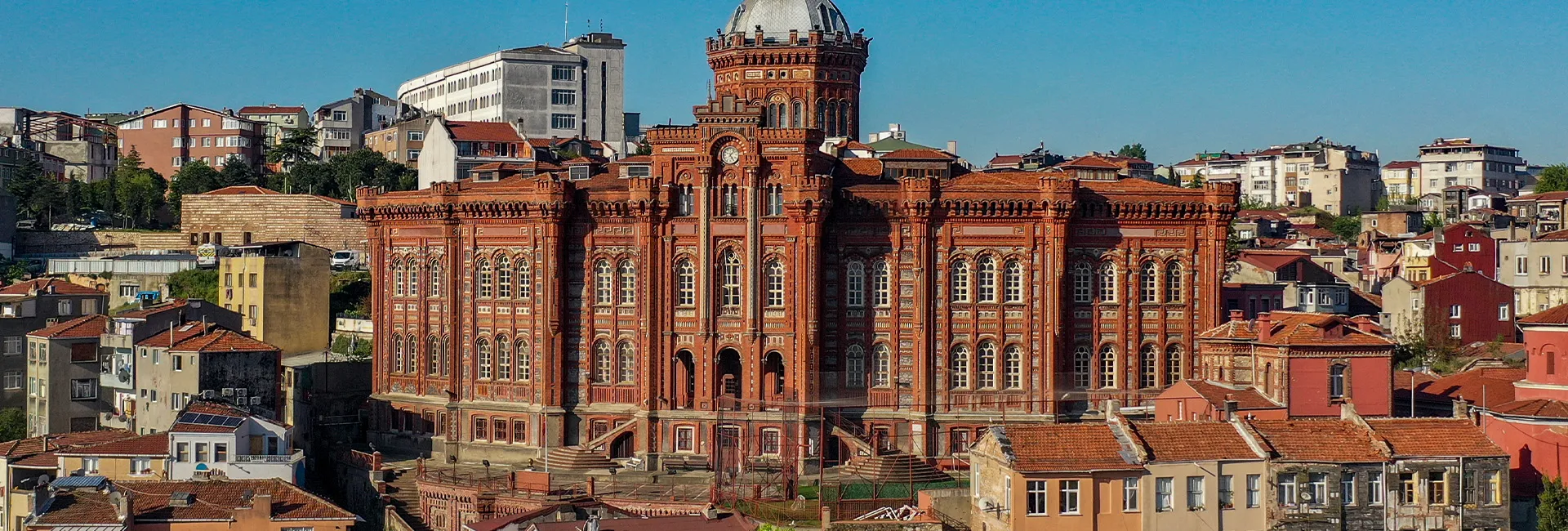
A Guide to Orthodox Churches in İstanbul
İstanbul’s multicultural heritage is like the branches of a millennia-old tree, reaching back to the roots of the many communities that once lived on these lands and left their traces behind. Through massive buildings and the stories being told, the buried past of İstanbul's people breathes. Orthodox churches in İstanbul are among the witnesses to the city’s past, reflecting its long and multicultural history. Those familiar domes, their beautifully aged icons and the enduring stone walls all carry the deep-rooted heritage of Eastern Roman (Byzantine) and Ottoman history with a quiet dignity.Here’s a brief guide to know more about the history and features of İstanbul’s Orthodox churches:
Introduction to the Christian Architecture in İstanbul
İstanbul, as one of the main crossroads of cultures, hosts numerous churches and monasteries belonging to various Christian traditions. This cultural mosaic is reflected in architectural marvels situated in several neighbourhoods of the city.While wandering the streets of Beyoğlu, Karaköy, and Balat, you may encounter one of these well-preserved churches that have endured through the centuries. From small neighbourhood chapels to grand cathedrals, they showcase a wide variety of architectural styles and religious traditions. For history and architecture enthusiasts, these quarters create a map for exploring diverse buildings that belong to the Orthodox, Catholic, and Protestant communities. Many of these churches still serve as centres of local life, preserving customs and rituals that have quietly persisted through the city’s changing centuries.
Focusing on Orthodox Churches in İstanbul
İstanbul's Orthodox churches are mainly concentrated in districts such as Fener, Balat, and Galata on the European side, with a smaller number on the Asian side, particularly in Kadıköy and Üsküdar. Many of these churches date back to the Eastern Roman (Byzantine) period, with several rebuilt or restored during the Ottoman era, spanning roughly from the 11th to the 19th centuries.Architecturally, they typically feature domed roofs, richly decorated iconostases, and interior frescoes or icons, reflecting Eastern Roman (Byzantine) tradition and later architectural influences. These churches remain important not only as places of worship but also as cultural and historical sites, preserving the legacy of İstanbul’s Rum (Anatolian Greeks) Orthodox community.İstanbul has a large number of Orthodox churches, more than any other Christian denomination in the city. Many of these churches are centuries old and include sacred water sources known as ayazmas, used for religious rituals.
Highlights of the Orthodox Heritage
İstanbul hosts many Orthodox churches across the city, each with its own story and character. This selection highlights just a few of the city’s most remarkable churches, many of which showcase centuries of history and distinctive architecture.The Fener Greek Patriarchate and the Church of St. George, Golden Horn/ FenerThe Fener Greek Patriarchate is considered the most important Orthodox church in İstanbul, as it has been the seat of the Ecumenical Patriarchate in the Fener district since the 17th century. The Patriarchate’s main place of worship, the Church of St. George, was built in 1836, replacing an earlier monastery church on the site.The Church of St. George is still an active place of worship and houses several important religious and historical treasures. Inside, visitors can see a carved patriarchal throne dating back to the 5th century, a fragment of the column to which Christ was bound before the Crucifixion, and relics and icons of various saints.Chora, BalatChora, also known as Kariye, is considered one of İstanbul’s most important Eastern Roman (Byzantine) monuments and is often regarded as second only to Hagia Sophia in significance among the city’s surviving churches. It formed part of a monastic complex dating back to the early centuries of İstanbul and was rebuilt in its present form in the 11th and 14th centuries. Today, it is renowned for its outstanding Late Eastern Roman (Byzantine) mosaics and frescoes and for its layered history as a church, a mosque, a museum, and, since 2020, once again a functioning mosque.This Greek Orthodox church is especially famous for its richly decorated interior, which preserves some of the finest surviving examples of Eastern Roman (Byzantine) painting. Inside, visitors can see elaborate mosaic cycles depicting the lives of the Virgin Mary and Christ in the narthexes, the iconic image of Christ Pantokrator with the donor Theodore Metochites, and the celebrated Anastasis fresco in the funerary chapel, showing Christ raising Adam and Eve from the dead. Hagia Triada Church, TaksimThe Hagia Triada Church, built in 1880 near Taksim Square, is the largest Greek Orthodox church in İstanbul. It remains an active place of worship for the Orthodox community and enchants visitors with its unique interior and exterior architecture. Its exterior features a large central dome supported by four semi-domes, while the façade showcases neogothic arches, a rose-shaped window, and neoclassical details. The inner walls are adorned with icons depicting Christ, the Virgin Mary, and various saints, complemented by stained-glass windows.Sveti Stefan Church (Iron Church), BalatSveti Stefan Church, also known as the Iron Church, is a Bulgarian Orthodox church which was built in 1859. Its three-aisled basilica combines Neo-Gothic and Neo-Baroque elements, with a 40-metre-high bell tower and six bells from Russia. Its exterior, including columns, arches and decorative details, is entirely cast iron, giving it a striking appearance.At the heart of Balat, it is the world’s only surviving iron church today, renowned for both its religious and architectural importance. After an extensive restoration from 2011 to 2018, the church reopened on its 120th anniversary in January 2018 and remains the only active Bulgarian Orthodox church in İstanbul. Church of St. Mary of the Mongols (Bloody Church), FenerChurch of St. Mary of the Mongols, which takes its popular name “Bloody Church” from the deep red colour of its exterior, was first built in 1261 by Maria Palaiologina. It is the only church in the city to have remained in uninterrupted Orthodox use since the Eastern Roman (Byzantine) period, making it a unique landmark in Istanbul’s religious history.The small, single-domed church features a modest apse, with traces of historic frescoes and a rich collection of Eastern Roman (Byzantine) and later icons. It continues to serve the local Orthodox community and, as a church dedicated to the Virgin Mary, observes the major feasts in her honour, including the Presentation of the Virgin on 21 November. Although it is not regularly open to visitors, it remains an important place for understanding the Greek Orthodox heritage of İstanbul.The Church of St. Mary, VefaThe Church of St. Mary in Vefa, commonly known as Ayın Biri Kilisesi (“the Church of the First Day of the Month”), is a Greek Orthodox church in İstanbul’s historic Vefa district. Rebuilt in the 19th century on the site of an earlier Eastern Roman (Byzantine) sanctuary with a holy spring, it is today best known as a living pilgrimage site that attracts people of different faiths from across the city.The church remains an active place of worship and is especially famous for the ritual held on the first day of each month. On that day, visitors queue to enter, light candles, drink or collect water from the sacred spring, and make wishes for health, marriage, prosperity, or other personal hopes, often receiving a small key that symbolises the “door” their wish will one day open.Church of St. Mary of the Spring, BalıklıChurch of St. Mary of the Spring, founded in the 6th century, is a historic pilgrimage site. Its holy spring (in Turkish, ayazma) is believed to have healing properties, and according to legend, the fish in the spring performed miracles, which contributed to the site’s fame.The current building, reconstructed in 1835, continues to serve the Orthodox community. Beneath the church, water flows naturally from the spring chamber, and the complex also contains the tombs of several Greek Orthodox patriarchs. It remains an active church and a popular pilgrimage site, especially during the annual Feast of the Spring after Easter.
Aya Haralambos Church
Aya Haralambos Church, within the Balıklı Greek Hospital complex, was established in the 18th century. The church honours Saint Charalambos, the patron saint of healing, revered by the Orthodox faithful. According to tradition, the saint's intercession has long been sought for protection against plagues and illnesses and has drawn believers to the site.Rebuilt in the early 20th century after earlier reconstructions, the church remains integral to the hospital. Adorned with intricate frescoes and icons, it features a serene inner sanctum where prayers for the sick echo daily, and the complex preserves relics associated with the saint. It continues as an active place of worship for the Greek Orthodox community and a spiritual anchor for patients and visitors.
General Information for Visitors
Many of İstanbul’s historic Orthodox churches are open to visitors on most days, generally from morning until late afternoon. Access can be limited during liturgical services, which often take place earlier in the morning or around early evening. Regular services follow the Orthodox calendar: weekday mornings and evenings often include short devotions, Saturdays usually feature vespers, and the main liturgy is held on Sunday mornings.Visitors are expected to dress modestly, keep noise to a minimum and avoid using flash photography inside. If you want to explore the architecture and icons in a quieter setting, visiting on a weekday outside major feast days, preferably between late morning and mid-afternoon, usually provides the most comfortable experience.