
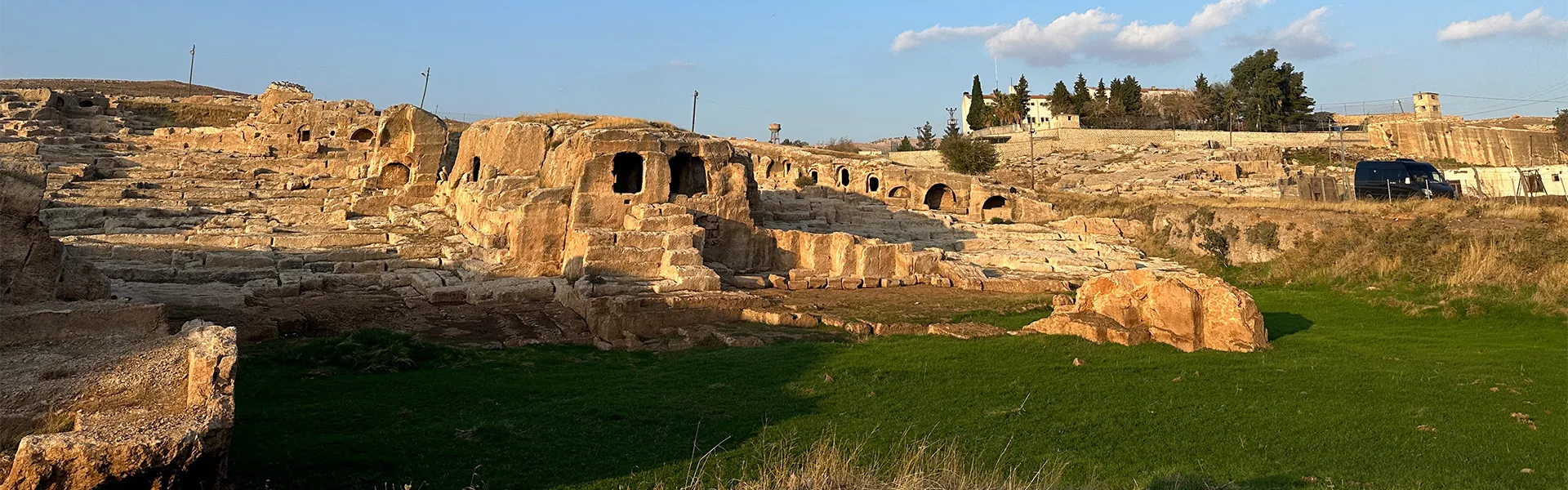
Dara Archaeological Site: Discovering a Lost City of the East
Mardin hosts a centuries-old legacy of ancient civilisations by preserving the architectural and cultural traces of them. Located near modern-day Mardin in southeastern Türkiye, close to Oğuz Village, Dara Archaeological Site is among the well-preserved ancient sites of the region.
Discover Dara along with Mardin’s layered and multicultural history preserved through its stone-carved wonders and enduring stories.
The Brief History of Dara
Dara, later known as Anastasiopolis, first appears in historical records in the writings of Gnaeus Pompeius Trogus, a Roman-era historian. According to some later historians, the city takes its name from the Persian king Darius III, who reportedly perished there while fleeing Alexander the Great's forces during their conquests in the 4th century BCE.
Originally built as a frontier fortress city by the Romans in the early 6th century CE under Emperor Anastasius I, Dara served as a vital bulwark against Persian incursions. For centuries, it remained a major Eastern Roman (Byzantine) stronghold, leaving the city with impressive defences and a grand urban design capable of housing up to 25,000 people.
The city’s creation was a direct response to the military failures of the Byzantine forces during the Anastasian War (502–506 CE). Recognising the lack of a solid military base in the region to counter the Persian fortress of Nisibis, Emperor Anastasius ordered the construction of Dara in 505 CE.
Later, in 530 CE, the famous Byzantine commander Belisarius successfully repelled Sasanian attackers at the historic Battle of Dara. After decades of shifting control between global powers, the city ultimately fell to the Muslim Arab conquests in 639 CE.
Dara adapted under successive powers, including the Umayyads, Abbasids, Seljuks, Artuqids, and Mongols, between the 7th and 15th centuries. It survived as a trading hub and military outpost until its gradual decline.
Today, the site endures as a significant archaeological site near Mardin, with its ruins of towering walls, rock-cut tombs, and underground reservoirs revealing layers of ancient ingenuity and conflict.
The Remnants of Dara
Dara Archaeological Site extends over a wide area, where key ancient structures, such as its monumental cisterns, rock-cut tombs, and fortifications, remain remarkably intact. From the remnants of residential quarters to public spaces, many historical features are well-preserved, allowing visitors to sense the echoes of antiquity as they explore each surviving feature.
Excavated remnants include the Necropolis with its rock-cut tombs, the massive city walls stretching 4 km with towers up to 20 metres high, grand underground cisterns for water storage, a sophisticated aqueduct system, the striking Grand Church, extensive living quarters carved into the rock, noble residences, an agora, and a street lined with columns.
While these sites first welcomed visitors in 2010, archaeological work remains ongoing nearby, constantly revealing new and intriguing layers of the ancient city. To truly understand the grandeur of this 'Mesopotamian Ephesus,' let’s take a closer look at the monumental structures that define the city:
Necropolis
Dara's Necropolis ranks among the site's most prominent features, featuring an extensive burial ground with chambers and tombs meticulously carved into the rugged limestone hillsides overlooking the ancient city.
Its standout attraction is the tomb chamber, now viewable through a sturdy glass floor installed for preservation. Within this chamber rests a finely crafted stone sarcophagus, tied to a compelling local legend of a woman buried alive who astonishingly revived and clawed her way back to life, a resurrection story passed down through generations and embraced as part of the site's enduring folklore.
The Great Cistern (The Dungeon)
The structure popularly known as the “Dungeon” (Zindan), due to its imposing underground chambers, was actually a colossal, multi-level water cistern. Connected directly to the city's water infrastructure, this massive rock-carved reservoir features a 15-meter-high vaulted ceiling built to store vital water supplies. It highlights the site's strategic engineering for prolonged sieges and frontier defence.
Agora and Columns Street
Dara's Agora served as the bustling heart of commercial and social life, surrounded by a collonaded street lined with sturdy columns that once supported porticos. Merchants traded goods from across the empire amid workshops and public fountains in this open marketplace. The layout reveals sophisticated urban planning typical of late Roman frontier cities.
Cisterns
Dara's wider network of cisterns ranks among the engineering marvels of late antiquity, consisting of various vast underground reservoirs hewn from solid rock to store water channelled from distant hills via aqueducts. Multi-chambered with arched ceilings, this interconnected system sustained 25,000 inhabitants through months-long sieges without external supply. Their scale and ingenuity underscore the city's preparedness for constant Persian threats.
Grand Church
Dara's Grand Church occupied a prominent position atop a two-storey cistern, its ruins today preserving one towering wall amid scattered columns and foundations. Built in the 6th century as a cathedral for the city's Christian population, it featured a basilica layout with intricate stonework. The structure symbolises Byzantine cultural dominance in this contested border region.
Other Structures
Remaining features include the 4 km city walls with towering bastions, the Necropolis's rock-cut tombs, aqueducts feeding the water system, and rock-hewn living quarters dotting the slopes. Ongoing excavations continue to reveal workshops, streets, and noble homes near modern Mardin.
General Information for Visitors
Dara Archaeological Site has welcomed visitors since the 2010s, following its recognition as a protected zone, while archaeological excavations at the site have been ongoing since 1986. Today, its vast complex spanning hillsides and valleys requires several hours to explore fully, so arriving in the early morning allows comfortable navigation in cooler temperatures before midday heat sets in. Comfortable shoes prove essential for uneven terrain and rock-cut paths, while guides enhance understanding of the layered history amid the ruins