
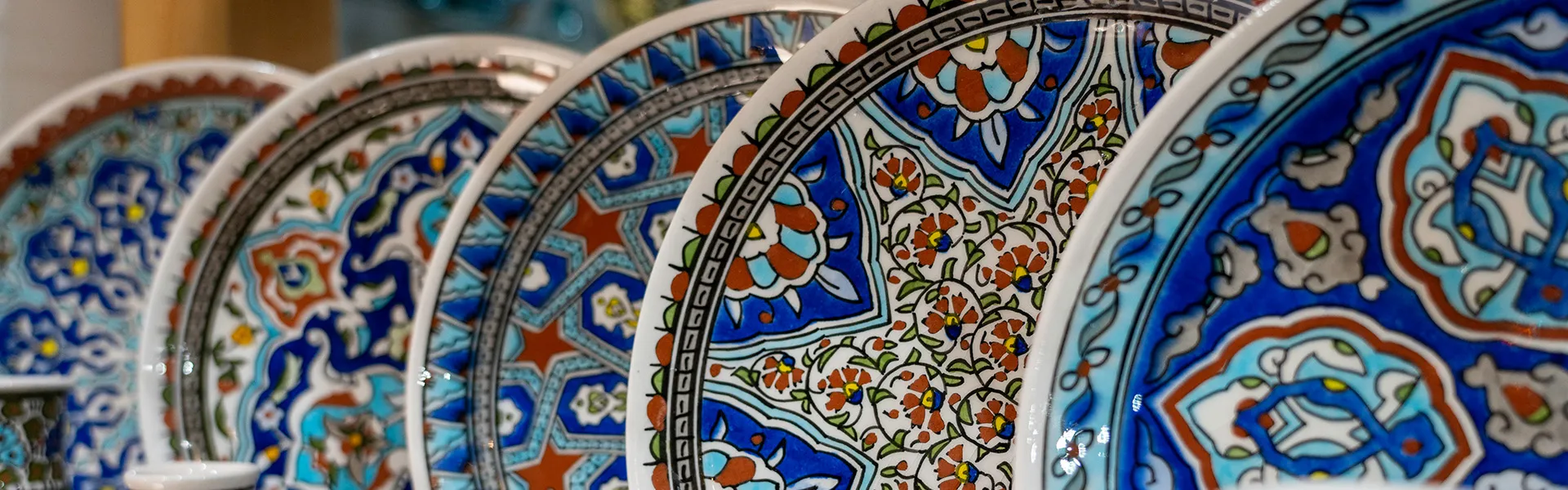
Çini Tradition: Colours, Craftsmanship and Cultural Memory
Çini is one of the world-famous faces of Turkish art, recognised by UNESCO as part of Türkiye’s intangible cultural heritage. From mosque walls and tombs to fountains, homes and contemporary public buildings, these small glazed tiles create a continuous visual thread between past and present. Their vivid colours, rhythmic patterns and careful craftsmanship reflect centuries of skill, devotion and imagination.Çini can be described as traditional handmade glazed tiles and ceramics, usually produced on a white body and decorated with stylised plants, animals and geometric motifs. They appear on facades, interiors and domestic objects across Türkiye, forming a familiar part of everyday life as well as religious and ceremonial spaces.In this blog, we will briefly explore how çini emerged and evolved, how it is made, which motifs it favours and how it continues to live as a cultural heritage today.
From Seljuk Walls to Ottoman Palaces
The story of çini in Anatolia begins with the Seljuks, who ruled large parts of the region between the 11th and 13th centuries. In cities such as Konya, Kayseri and Sivas, they decorated mosques, madrasas and caravanserais with cut-mosaic and glazed tiles in deep turquoise, cobalt and dark green. These tiles transformed otherwise plain stone facades and interiors into shimmering surfaces, charged with symbolic colour and light.With the rise of the Ottomans, tile production moved into a new phase. From the late 15th century, İznik became the main centre for high-quality ceramics, producing a white, quartz-rich fritware body that provided a clean background for painted decoration. At first, İznik wares were mainly in blue and white, echoing imported Chinese porcelain while developing their own distinct patterns.During the 16th century, İznik ateliers reached their peak. Turquoise, green and purple joined the palette, followed by the famous raised bole red that gave many tiles a warm, almost velvety accent. Large tile cycles were produced for imperial mosques, tombs and palaces, especially in İstanbul, where architect Mimar Sinan used them with great sensitivity in buildings such as the Süleymaniye Mosque and Rüstem Paşa Mosque.By the 17th century, economic shifts and changing tastes led to a decline in İznik production. Kütahya gradually took over as a major centre in the 18th and 19th centuries, while Çanakkale became known for more folk-inspired ceramics. Together, İznik, Kütahya and Çanakkale formed the three main hubs of Ottoman tile and ceramic art, each with its own character and audience.
How Çini Tiles Are Made from Clay to Glaz
Although styles have changed over the centuries, the basic principles of çini-making remain constant. Traditionally, artisans work with a white-bodied ceramic, often rich in ground quartz, which is shaped into tiles or vessels and left to dry. Once the raw piece is ready, its surface becomes a kind of blank page for the painter.The design is usually sketched lightly, then carefully outlined and filled with mineral-based pigments. Deep cobalt blue, fresh turquoise, rich green and warm red are applied in balanced combinations that have become visually synonymous with Ottoman and Turkish tile art. When the painting is complete, a transparent glaze is spread over the surface, and the piece is fired in the kiln, fixing colours and patterns into a glossy finish.This process demands patience and control at every stage. Any change in the glaze, the pigment mixture or the firing temperature can affect the result. Cracks, blurring or unexpected colour shifts may appear, which is why the knowledge of master çini-makers is valued as much as the finished tiles themselves.
Understanding Motifs and The Visual Language
The visual language of çini is layered, balanced and guided by long-established conventions. Floral motifs are among its most recognisable features. Tulips, carnations, roses and hyacinths appear in countless variations, sometimes naturalistic and sometimes gently stylised. These flowers recall both real gardens and the idea of a heavenly garden, suggesting beauty, abundance and renewal.Alongside flowers, elongated saz leaves, cypresses and scrolling branches create a dynamic rhythm across the surface. Geometric patterns, stars and interlacing forms add another layer, reflecting broader Islamic artistic principles that favour repetition, balance and controlled complexity.In many religious settings, çini also incorporates calligraphy. Qur’anic verses and pious phrases, written in elegant scripts, are framed by floral and geometric borders. Within a mosque or turbe, these inscriptions help shape the spiritual atmosphere, guiding the viewer’s gaze and reinforcing the sacred character of the space.
Çini in Architecture and Everyday Life
In Ottoman and later Turkish architecture, çini played an important role in decorating interior spaces. Tiles were used around mihrabs, on lower wall sections, in domes, on window frames and in private rooms, adding colour and a cool, smooth surface that responded beautifully to light.Beyond major mosques and palaces, tiles also appeared in smaller neighbourhood mosques, fountains, turbes and homes. A panel of çini in a house or a modest shrine could bring the prestige of courtly art into daily life, turning an ordinary wall into a carefully composed image. In this sense, çini has long bridged the worlds of monumental architecture and intimate domestic space.Today, visitors can still encounter historical tiles in many parts of Türkiye, from İstanbul and Bursa to Konya, Edirne and beyond. At the same time, new buildings, metro stations and public interiors continue to use contemporary çini panels, which echo classical patterns while responding to modern settings.
Çini as a Living Heritage
Despite the breaks and revivals of history, çini-making remains a living craft. Ateliers in İznik, Kütahya and other cities continue to produce tiles and ceramics using traditional methods, often combined with contemporary interpretations. Some artisans specialise in restoring historic panels, while others create new works for mosques, cultural institutions or private collections. In 2016, the traditional craftsmanship of çini-making in Türkiye was inscribed on the UNESCO Representative List of the Intangible Cultural Heritage of Humanity. İznik, Kütahya and Çanakkale are also included in the European Route of Ceramics, part of the Council of Europe Cultural Routes programme. These recognitions emphasise not only the beauty of the finished tiles but also the skills, techniques and social relationships that surround their production. Apprenticeship, culture and the transmission of knowledge are all considered essential parts of this heritage.Contemporary artists and designers are also exploring new methods to work with çini. Some develop site-specific installations that reinterpret classical motifs at a different scale, while others experiment with unexpected colour combinations or abstract compositions. Even in these new forms, the connection to the historical tradition quietly shapes the work and keeps the story of çini moving forward.
Cultural Memory Written on Tiles
Rather than serving only as decoration, çini tiles also record stories of place, patronage and craftsmanship. It carries traces of empires, cities, ateliers and individual hands, bringing together technical skill and a shared visual memory. From Seljuk turquoise tiles to the deep reds of İznik and the continuous production in Kütahya, each period has added another layer to this tradition.Today, when we look at a wall of tiles in a mosque, a museum or a simple neighbourhood fountain, we see not only a pattern but also the echo of centuries of craftsmanship. As long as artisans continue to shape clay, paint motifs, and fire their kilns, the art of çini will remain a quietly luminous part of Türkiye’s cultural life.